

Zig's Online Business & Community Directory for the Holsworthy Area

We left the story of the Church Building at the end of the 13th century so must now consider what happened afterwards. As far as I know the 14th century has left no traces, doubtless they had to cobble and patch and keep the rain out. Roofing must have been a plaguey business, when, instead of slates, shingles were used ; just slabs of wood overhanging each other like tiles. In the end ot the 15th century and possibly in the earliest part of the 16th much was done. It seems that the two Carminow daughters with their husbands lengthened the south aisle by putting a chapel at the east end of it-which chapel was divided from the chancel and east part of the nave by a granite arcade. The granite window at the east of the aisle still has the Carminow, Courteney and Carew arms which correspond to the arms on the cuspings of the Carminow monument also put up by them at the same time. There is a monogram in the glass of that east window as well as the shields with the arms. This monogram is an M and probably shows that the new end of the aisle, or a least the Eastern part of it, was dedicated to the Blessed Virgin, in other words, a Lady Chapel. It seems that they put a new roof from end to end of the aisle-on old portion and new alike, as there is no break showing in the work. About that time too and very likely as part of the same scheme a screen was thrown across the Church-cutting off the chancel and the Lady Chapel-and the Rood stairway was made. Whether the Carminow monument was also screened I cannot say. The granite windows of the south aisle and the square headed south doorway raise a question whether they were put in now or in the big Restoration in 1677 - I should be inclined to say now, only they spent so large a sum of money in 1677, that it is difficult to see how they employed it, which suggests that the door and windows may have been put in then.
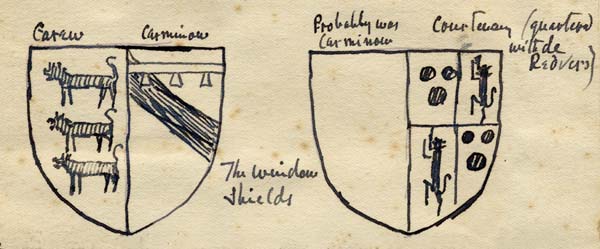
The old rule of Heraldry was that the husbands half of the shield was on the Dexter or right hand (i.e. the shield's right hand, not your right hand as you looked at it).
The Carew-Carminow shield above follows the rule-but if the blank space is Carminow, and if it refers to Hugh Courtenay and Margaret Carminow the second Shield breaks the rule.
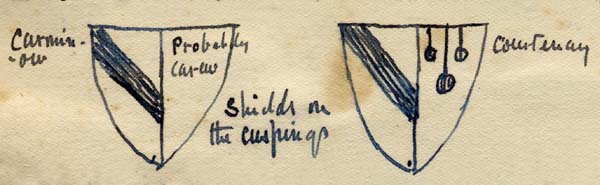
Again if these cusping shields refer to these two marriages of Margaret and Joan with Carew and Courtenay - they both break the rule. Heraldry was well understood in those days, so a mistake does not seem likely, and yet it is difficult to think that the shields can refer to other marriages between the three families.
During the Carminow reign it seems that the carved oak benches were put into the Church. In fact if you wanted to see Ashwater Church at its best you would have to go back and live at the end of the 15th or beginning of the 16th century.
There is another feature of the Church which should be mentioned here though it brings several puzzles with it. I mean the portion used as the vestry at present, sometimes called a Transept-but sometimes, and more properly, I think a Chapel. When was it built ? It looks as if it had been built up against the nave; its roof is quite apart from the nave in structure (compare Broadwood.) The wall plate, renewed in 1904, has the same pattern as the one it replaced - not a very old design, and the window in the gable was free stone of much the same shape as the present granite perpendicular one, judging from the jambs etc which were found when the vestry chimney of 1816 was pulled down. All this makes one suppose that it was built about the 15th or 16th century. On the other hand, the present building might concieivably be on the site of an old Transept.
There was an old foundation discovered crossing the South Aisle - more or less opposite the west wall of this puzzling building (so Mr. J. Northcott tells me-which is rather evidence that there may have been a cruciform church-but, if so it must have been before the 13th century building, as a cruciform church would not have wanted those 13 century pillars-so there we are puzzled.
Next month I shall get to something more certain and shall leave“ probably and perhaps, possibly and suppose” (an irritating lot) behind, for a while at least.
The Royal Arms has its date on itself for all to read, 1638. It is made of plaster and is of a fine bold design It reminds one of the Arms at Clawton which is also of plaster but is much later for in the Warden’s accounts of that parish for 1662 there is the following entry - paid Peter Netherway for setting up the King’s Arms £2.
There are three shields carved in wood above the Carminow monument. The two outer shields have the arms of a well known family called Short who for a time had a lease (probably for certain lives) of the Manor and advowson of Ashwater and who lived at the Barton. I hope to say more about this later on. The central shield has the arms of Joseph Hall who was Bishop of Exeter from 1627 to 1641 when he was translated to Norwich This shield has the Cathedral Arms on one half (Cross keys for St Peter and sword for St Paul), on the other half is the Hall family arms showing 3 Talbots heads. A Talbot was the old name for a bloodhound.
Mr Northcott tells me that this carving was found at the Restoration undertaken by Mr. Feild late in the 19th century. It was lying somewhere unregarded underneath the Western Gallery.
It is supposed that some work in the way of restoration or improvement was carried out during the Episcopate of Bishop Hall and that the Shorts had a chief hand in it; this carved work being put up in memory of the undertaking.
A Bell was cast in Ashwater in 1671 by “ Mr. Penitent,” -so say the warden’s accounts. His name is spelt Pennington in 1721. They were a well-known bell founding family and lived at Cullumpton He was paid £10, but much of the work seems to have been done by the people of Ashwater on the spot.
Our earliest existing Churchwardens’ accounts begin in 1663. Those at Clawton begin 70 years earlier and should make us green with envy and jealousy. Nevertheless our own are “chockful ” of interesting information.

 Website by